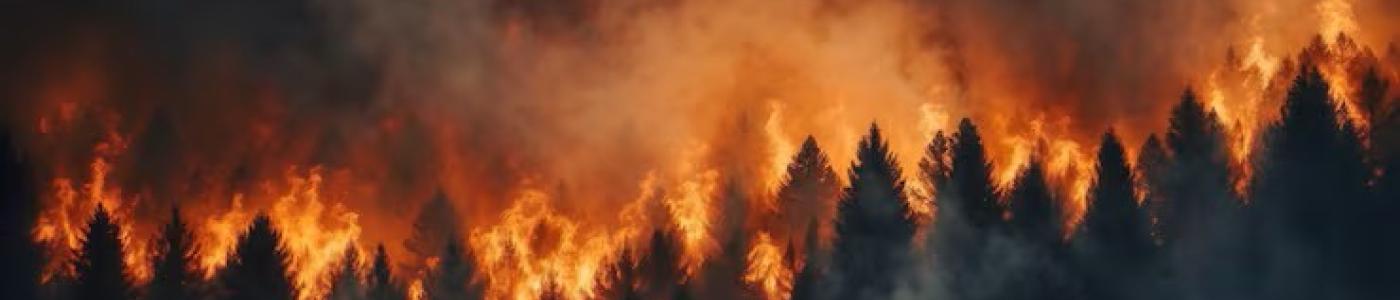
The combination of lower than normal winter snow accumulations and longer, hotter and drier summers has led to an ever-increasing risk of forest fires occurring in our local forests and greenspaces.
Due to this increased risk, it is important that you do your part to prepare for and help mitigate the risk of a wildfire occurring in your neighborhood.
Prepare for a wildfire
- Make a household emergency plan.
- Prepare your emergency kits.
- Practice your primary escape route, as well as alternative routes out of your community.
- Be familiar with local and provincial emergency management organizations, their plans and evacuation procedures.
- Take time to learn about emergency planning in your area.
- Remove any fire hazards in and around your home, such as dried out branches, leaves and debris.
- Keep a sprinkler in good working condition available.
- Have smoke detectors on every level of your home, preferably in every bedroom.
- Have carbon monoxide alarms in your home that are in proper working order.
- Know how to turn off the utilities in your residence.
- Make sure that your vehicle is fully fueled. If evacuated, stopping to refuel could be difficult depending on your region or distances.
During a wildfire
- Monitor local radio, television, or social media for information, warnings, alerts or evacuation orders from authorities and emergency officials.
- Follow instructions. Be ready to leave.
- Pack your emergency kit and any valuables or items that cannot be replaced in your vehicle, in preparation to evacuate.
- Park your vehicle, positioned forward out of the driveway. Keep car windows closed.
- Close all doors and windows.
- Cover vents and other openings to your house to limit smoke entering your house.
- Turn on all lights in the house, porch, garage, and yard for increased visibility.
- Place a ladder to the roof in the front of the house to assist firefighters.
- Move propane barbecues and other combustibles, including firewood and lawn furniture, away from structures.
- Turn off propane or natural gas if you evacuate.
During a wildfire smoke event
- Monitor radio, television or local social media accounts for air quality statements or air quality advisories issued for your location.
- Consider reducing, rescheduling, or stopping strenuous outdoor activities. Seek medical attention if experiencing symptoms.
- Limit time outdoors.
- Keep windows and doors closed as much as possible.
- If you must spend time outdoors, a well-constructed, well-fitting, and properly worn respirator type mask (such as a NIOSH-certified N95 or equivalent respirator) can reduce your exposure to the fine particles (PM2.5) that represent the main health risk from wildfire smoke.
FireSmart
Overview
Established in 1993, FireSmart Canada is a national program dedicated to helping Canadians enhance their neighbourhoods' resilience to wildfires and reduce their adverse impacts.
The provincial FireSmart NB program focuses on local needs and challenges to provide tailored resources and guidance to equip New Brunswickers with the tools to protect their homes, businesses, and communities from the increasing threat of wildfires in our changing climate.
Join the FireSmart movement
FireSmart offers practical, effective, and science-based programs that equip you with the tools to better prepare for wildfire incidents.
It starts at home
FireSmart principles focus on specific actions residents can take within these vulnerable areas, known as the Home Ignition Zone.
Take action today
You can make a difference. Small, proactive steps today can lead to significant, lasting impacts on wildfire resilience.